Direct answer
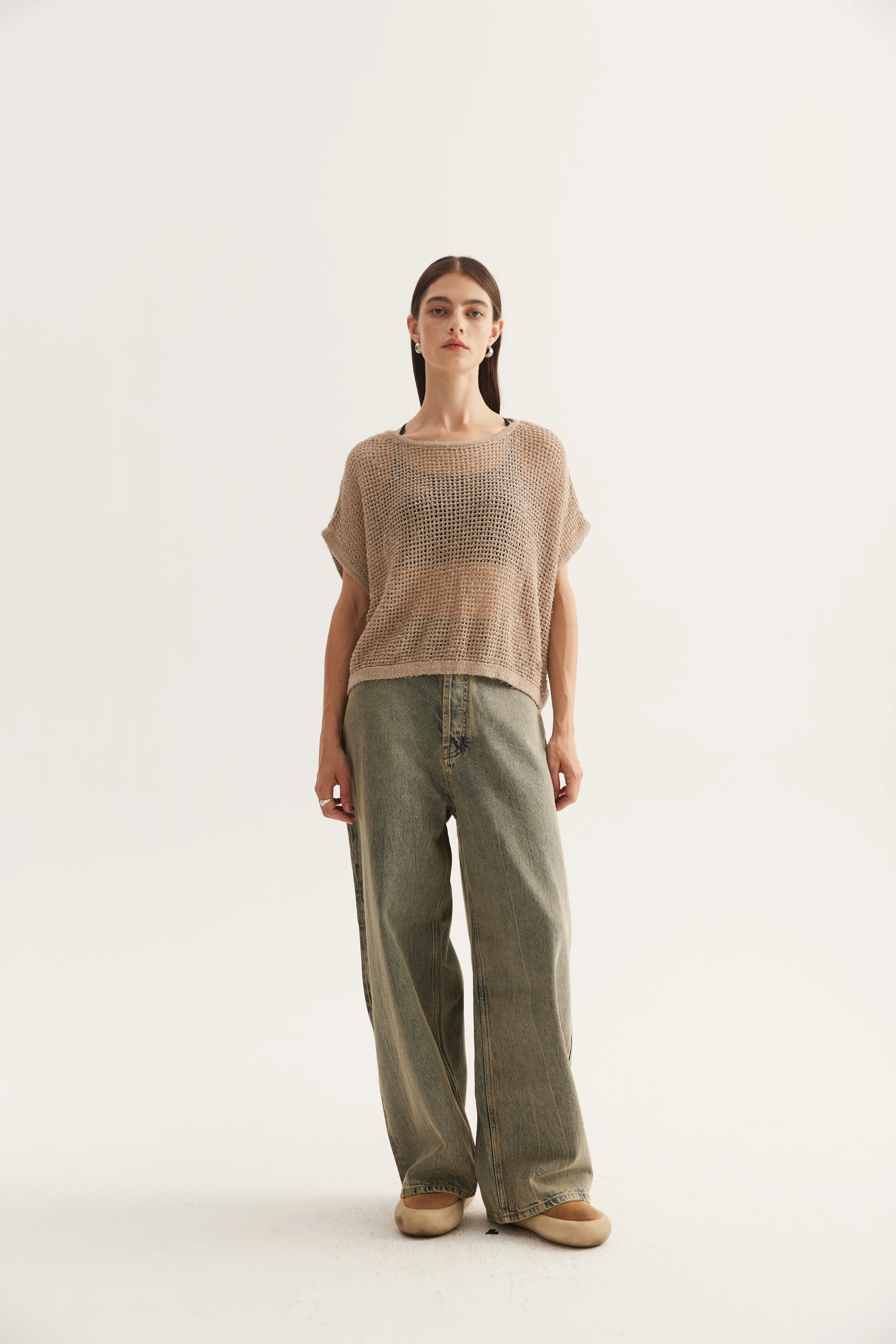
Openwork knitwear is specified through transparency, hole scale, coverage, garment boundaries and finished dimensions together. A swatch establishes the open structure, and the complete garment confirms the neckline, extended shoulders, sleeve openings, hem and behavior after the agreed care route. The selected yarn record provides the legal linen percentage.
Specify openness through the wearing result
Hole scale and repeat are only part of the brief. The useful target also describes transparency, intended layering coverage, motif distribution and whether the open field should remain consistent across body, shoulder and side areas when the garment is worn.
Develop stable boundaries around the open field
The neckline, extended shoulders, sleeve openings and hem carry a different structural role from the open body. Their density, width and transition into the motif preserve the agreed shape, transparency and opening dimensions.
Build the composition claim from the selected yarn
The selected yarn specification and applicable documentation provide the legal fiber names and percentages. This material statement travels with the approved visual openwork target into production.
Choose tests for the actual risk
Extension, recovery, tensile behavior, snag exposure and dimensional change address different performance requirements. LuMiao selects the relevant method and conditions from the intended use and material route.
Approve in a swatch-to-garment sequence
Swatches can resolve motif scale, transparency and yarn-structure direction. A garment sample then confirms neckline and opening behavior, silhouette, dimensions and care response. Fiber content, numerical limits, testing scope and timing remain specific to the project.
BUYER QUESTIONS
How does openwork scale affect the garment?
Hole and repeat scale change transparency, coverage, local extension, edge transitions, visual distortion and snag exposure. LuMiao evaluates these effects with the selected yarn, loop geometry, density, motif placement and complete garment construction.
How are neckline and sleeve-opening behavior approved?
The swatch establishes the open field and compares structural directions. A complete sample then confirms the neckline, extended shoulder, sleeve opening and hem under the garment's actual shape and weight.
How is a linen or linen-blend composition published?
The selected yarn's supplier or test documentation provides the fiber names and percentages, which are then stated according to the labeling rules of the target market.
Which dimensions should be reviewed after the agreed care condition?
Review the measurement points that define the actual silhouette, including body length and width, neckline, shoulder or sleeve opening, hem and any other project-critical span. The washing, drying and conditioning route must be recorded with the comparison.